Monday, 14 March 2016

13rd March 2016

One week ago I was in CCB and I embraced Sandra after a performance.  
I realized that her vocal dance has been a door to cosy inner homes.  
Suspension.

I was today in CCB and I spoke with Pedro Ramos after his performance. He was in another dimension. 
Also, I looked to the installation and I had a different sensation about the space. It looked like it is in another dimension, out of time.
Pedro told me that he feels that he is now an inhabitant of a whale’s body. 
Then, I understood. I believe that also the installation feels that it has become an home. 
Suspension.

I changed my beliefs about what is an inhabitant and what is an home. 
So, I transformed my home.
Isn’t this what is art for ?


5th March 2016
Afterthoughts on "ZYG Variations” 

"ZYG Variations" is a training proposal addressed to adults that work with infants and children (educators, kindergarten assistants, teachers, artists, psychologists, music therapeuts, etc) very much inspired on the ZYG playing atmosphere. 
In contrast with the most part of training courses, there are no settled aims to attain in this short training course. We just want that trainees have the opportunity to experience the same type of enjoyment that infants and children can experience with ZYG. We just want to provide opportunities for playing, for being in self contact, for being in others’ contact. We care the carers, they will care of others.  
No aims, just a sentence guiding body and vocal improvisation: “music is needed when sound is not in tune”.
No aims, just an expression guiding sensorial contact: listening in spatial time.
No aims, just a key word: readiness. 
No aims, just a key word: authenticity.
No aims, just a key word: presence.
“Communicative musicality” is a seed inside of every human being. It germinates in companionship of meaningful carers. It flourishes when, besides being prepared professionals, carers are genuine persons.

Saturday, 27 February 2016

How to prepare to be unprepared.


Zyg is an open installation which can lead to the sensations and also risk. The performer in improvisation can at his best offer the child a joint exploration and together they experience time and space, hopefully in a playful way. In the process with the performers we have emphasized to prepare for being unprepared. Through physical exploration and reflection the installation got significance for us who participated in the process. Practitioners have saved their experiences in the body's archive and with their archived experiences they now face the youngest children. Zyg is a room filled with opportunities and where an overriding goal is to offer the child a meaningful meeting. The meaningfulness in this context relates to providing the child interaction and response. Being together in experience, discovering the layers and to lift the child's initiative up is stated objectives. The open improvisation has its structure and it is always an artistic intention behind each installation. In the meeting with the child, the work completes and it gets its shape: new, unique and different from the previous one, never the same as the next. The performers must listen with all their senses in order to provide a sensoric experience, at its best children's sounds and movements are woven into the performer's interpretation of time and space. Other times it's more difficult to create a good meeting for everyone. The knowledge of the performer attached to such an open improvisational form requires a lot and presence is the most important tool to carry into this meeting. To be seen, heard and taken into exploration of time and space can create the most beautiful moment, that is how we want the child to experience Zyg.  

Wednesday, 24 February 2016

Opening and Further

ZYG has been a wonderful experience. A path developed over several months, initiated by a sharing of ideas, built by many doubts and a very strong desire to ask what is the essence of communication and how art (at the intersection of sound, movement and space) can create the lap where time and space inhabit the body of each person, in particular the babies. With the debut of ZYG, the presence of babies and parents, children and educators, brought the gazes of amazement, the impression of listening very deeply and a feeling of being in a profound relationship with the here and now.

During the next few weeks (until 12 March), ZYG will be at the "nest" that welcomed it when it was still an idea, the Fábrica das Artes, CCB. It has been a privilege. The affection, the accuracy of the work, the time, the exchange of ideas. There will be further presentations and also a number of training sessions that were called Variations on ZYG. They will be a living-reflection about the importance of artistic experiences in early childhood, constructed with the building blocks of ZYG´s universe. We are born musical, with the ability to make and enjoy sound and movement and it is essential that, since an early age, children build an "emotional / aesthetic" vocabulary made of rich, deep and diverse experiences. We will look at ZYG in three different ways. The first session will start by promoting an "emotional / sensorial" contact, followed by a "deconstruction" of the creative process and a set of listening activities and sound / musical expression. In the second session we will propose a look mediated by ideas such as communicative musicality, proto-comunication, nonverbal language, authenticity, inner availability, play. The third session will bring a vision from "inside the body" very influenced by ideas like "embodiement" (sound, space, time) and musicality of movement. It will also be the look by who is "being really there". We will not explain what can not (and should not) be explained: amazement is still the most fruitful way of knowing things. We will seek, with the adults, to continue learning what babies have taught us: to listen to the whole body, to look to the sounds, the touch the forms.


Tuesday, 23 February 2016

Opening

The first ZYG performances occurred on Friday 19 February with children from a kindergarten (3 years old). On the following Saturday and Sunday there were performances for groups of 6 babies (the groups were generally mixed, from 2 months to 3 years old) and 6 adults. On Saturday afternoon there was also the conference-performance, a format that included a first experience in the performing space (with Pedro and Sandra in a "dialogue") and then an open discussion with the audience (educators, artists, programmers).  It has been a wonderful experience: the presence of babies, their amazement, attention and communication brings a total new dimension for the work. The performance-conference, too, was a new breath. It was wonderful to share and discuss all the process. Always learning.


Friday, 12 February 2016

Thursday, 4 February 2016

Artistic Residence @ CCB #1

Day 1 and 2: assembling the structure and loudspeakers
Day 3 and 4: impro work

Wednesday, 27 January 2016

Some news from the Sound Front

We have been working on a solution for the sound diffusion in the structure. At the beginning we investigated the possibility of having a system composed by several mp3 players connected to commercially available portable loudspeakers (similar to what is being used in Toddlers Room or Opus 7). After seeing the real structure in Miguel´s atelier it became evident that any commercially available solution would be strange and we should design something that would make sense (visually) with all the rest. In the process we spoke with Rui Penha, a dear friend and collaborator, and we decided to create an original solution which would solve not only the visual problems but also the sound (off course) and the synchronisation of mp3 files (which may or may not be an important question). The drawing and photos show the idea currently being developed:


1) We will have 8 pairs of loudspeakers that have inside a LilyPad2 mp3 connected to a circuit that hosts a “xbee” micro controller (Rui Penha´s circuit). The LilyPad2 mp3 has an amplifier, connections to 2 loudspeakers, and an SD card. We have chosen Phonestar SQ-2504 loudspeakers and developed wooden pieces that will host them as well as the electronics and battery. 


2) The idea of  using “xbees” is to create a wireless network that is controlled by a “xbee master”. The master sends information to the receivers (Rui Penha´s circuit) and they send information to the LiyPad2 mp3 player. In other words, the master allows to synchronise all players and it is programable (Arduino). It is possible to write a program with a final sequence of files to be played or a more or less randomised sequence.
3) The system is wireless (except for the connection between pairs of loudspeakers) and fits into the structure so it looks that sound is emanating from the space itself. This is really nice because all the ideas we talked about defining a space have now a very elegant solution: the structure is very minimal (well, not really, if we look at the amount of work and effort needed to produce it and to assemble it) and it is the interaction of lines (pieces of wood) and sound that will create the sensation of being immersed. It has a lot of empty space around but it is very effective in creating a very conformable sensation of being “inside”

Rui is still developing some aspects of the programming and it looks that the maximum number o mp3 files is going to be 30. I believe this is more than enough. It would mean that we could work with a total of 240 sound files which is far more than we can deal with (both musically and in terms of the work with Sandra and Pedro). The length of the files is only determined by the capacity of the the SD card, so we can have many hours of music.

During the first week we will not be working with the final version of the system, but that is not a problem as we have agreed to work with Live as a composing tool. In fact, we will only “close” the program in the xbee master when we will have made decisions about the sounds and the order they will appear. I have already a selection of mp3 files that I have created or processed and, off course, the idea is to work with everyone, and Nils in particular, towards a wider pool.

Wednesday, 6 January 2016

A few thoughts about working in sound/music

Following the experiments with portable sound I have been investigating some directions that would allow us to produce the music/sound content of ZYG as a "dialogue" between all of us during the residence at CCB. I have been doing some experiments and working with the equipment that I have at home (Computer: Mac; Software: Live/Absynth; Audio Interface: Fireface 400; Loudspeakers: 4  ST Twin R37, 1 ST Disc04 R35; 1 JBL Clip; 1 Altec Lansing Orbit iM-237) just to test concepts. The final equipment solution will have to be much simpler but I would like to test a few ideas more before committing to buying new things (essentially loudspeakers).

I have been exploring the idea of having 6-8 independent sound sources (loudspeakers), each with it´s own musical contents, creating a "space" / "atmosphere" of sounds that have their individuality but seem to interact with each other. This "interaction" is "illusionary" since it is created by the listening. What I have doing is working with 8 Live tracks, some Midi some Audio, and organising very simple patterns with different lengths. The difference in lengths means that new listening patterns are created when the patterns are repeated in the computer. It is just the basic principle that allows us to hear melodies when bells in churches or monuments are playing, something that was used a lot in minimal music. I will investigate further the concept of Tintinabullation which I think can give nice clues to further this idea. The fact that I am doing this in Live means that there is a lot of parameters that can easily be changed and the result is very interesting: it is possible to create atmospheres that have a lot coherence (mostly because of timbre) but seem to evolve all the time (something that only happens in our minds). It looks like a "conversation", or as Part said, referring to his use of "tintinnabulation" the gradual unfolding of patterns implicit in the sound itself, and the idea of a sound that is simultaneously static and in flux. 

The nice thing about this is that it would very easily provide us a tool to interact with Siri, Pedro and Sandra. In other words, music can be constructed as we go along in the residence. It will eventually have to be fixed by the end (I wish this was not the case, but for technical reasons maybe it is the right decision) but this could be done at a later stage of the residence. In an ideal situation we would have sets of Live that the performers could manipulate (with some kind of interface or sensors) but this would require a computer and an audio interface allocated and this might make things a bit difficult. The alternative is to export the final result(s) to independent audio tracks that will be played by mp3 players, one per loudspeaker.

Tuesday, 8 December 2015

ZYG@Evento Caminho Percorrido, 5 Dezembro

ZYG was part of event Caminho Percorrido, an initiative of the Cultural Footprint Program that took place on December 5 at Mercado da Ribeira in Lisbon Market. It was a very lively meeting of the agents (portuguese and norwegian) and projects involved in the Program. The physical model of ZYG-Proto # 03 was exposed and we presented a talk about the ideas and work so far. The Prezi that was used is here.


A physical model of ZYG-Proto#3

This is a physical model of ZYC-Proto#3. As in the post with the drawings, this refers only to the structure (in wood). I included some of Gabriel´s Lego toys to give an impression of scale to the human body. One day we will have aliens, but not yet this time.

Tuesday, 1 December 2015

Some drawings of ZYG-Proto#3 (simplified version)

These are computer drawings of what I called initially the "latest version of  ZYG-Proto#2 (simplified version, i.e., without the mechanism that allows shaping the surface)" but now I refer to as ZYG-Proto#3.  I think it is clearer this way because there are important distinctions. They portrait the structure, to be made in wood, that could support a "skin" (or two) made of lycra. These drawings have been used to make a physical model (1:10) that should be ready to present on the even of the 5th of December. The showing on that occasion should be considered as an exercise that will allow us to analyse properly the proposals, not a commitment to a final decision.


Sunday, 8 November 2015

Some Experiments on Sound

Here are some experiments on possibilities to use electronic sounds. I gathered pieces of equipment  that we used in several projects where non-convential sound (i.e. front of stage loudspeakers) was needed. Namely: 1) Super Tooth Disc04 (used in early stages of Cidades Invisíveis); 2) Altec-Lansing IMT227 (used in Opus 7 and BBPP); 3) Super Tooth DiscoTwin (used in Babelim); 4) Fonestar Vibration Loudspeakers (TDO15 and TDO25) (used in Pianoscópio and Babelim). I fed them with audio from BBPP coming from a mp3 player.


I was particularly interested in the idea of  portable sound sources that would allow "moving the sound around" (this would mean the possibility of reconfiguring the distribution of sound in space as well as playing with movement both for the body and the sound source. I was also interested in the idea of "feeling the sound", i.e.. tactile feed-back in addition to auditory. I started by using some very basic solutions, stereo foam eggs and balls in which I placed the Altec Lansing loud speaker. 

The sound suffers a lot (in volume and quality) but I think it is possible to find a solution that would preserve it. It is really nice to move to sound around to share it with others and above all to feel it (there is a lot of vibration). There are many possibilities to improve the volume and quality, either working with this type of material or with other. And off course the aspect can be whatever we want (see for example last image of a ball covered with the flocking technique). I believe that Super Tooths (both) would also produce interesting results but I did not have big enough eggs or spheres to put them inside. But only working with sound being fed via the audio input, not via bluetooth. My experience with bluetooth in several artistic projects tells me not to do it here, particularly if moving around. The vibration loudspeakers don´t work either (I was really keen about this since they are particularly effective in making the sterofoam to vibrate) and even if we would make solid balls or eggs rather than empty as it was the case, we would always have the problem of "shaking" and "turning upside-down" (I might have damaged the TDO25 in a later experiment which I describe)


I also experimented with an aluminium campanula from Babelim (I simply placed the Altec Lansing inside). I works really well both as an object to hold and move around and as a sound source. In fact the sound its louder and I dare to say better. Again, this might not be the right aspect as far as the finishing and material is concerned, but ut would not be very difficult to find good alternatives. The shape of the object, however, might be a bit self referencial.


 The experiments with vibrating loudspeakers are a bit difficult to interpret. I´ve using them in projects like Pianoscópio and Babelim with excellent results but in those circumstances they are placed on the harmonic board of pianos. The idea of having a sound-irradiating-floor is something that I started to think about well before the ZYG project was conceived (last image is an early sketch for an immersive space that I started to imagine after an experience of sound massage in pitagoric table). So, I tried hard stereo foam and some thin wood planks as well as wood boxes. The sound results are a bit disappointing (gets better with boxes) but the vibration with the stereo foam is great. It reminds me the experiments we did at CdM when we were working with deaf people but with much better results, I think. Feeling the vibrations in the body is great but I might have damaged the TDO25 while exploring the possibilities. Definitely they don´t like to be moved around. It could, however yield good results in the floor. It would always involve many wires.


Saturday, 31 October 2015

A physical model to explain the structural principles of ZYG-Proto#2

This model attempts to explain the principies of: 1) modularity (ie, the structure can have different sizes since it is made go modules), 2) connectivity to a surface or surfaces that cover the structure (made of lycra, for example or any of the other options that have been identified in other people´s work) which makes the overall shape change. The "camshaft" on the top of the structure can be linked to any part of the structure and provides tension and release of tension as it moves (operated by the interactor or by automated means). The structure can hold sound and light projection devices.


Monday, 19 October 2015

Two ideas have been proposed by Miguel

I had a meeting with Miguel today and he presented two possible ideas. Please feed-back us about them.
ZYG Proto#01
It is a structure of overlapping pieces that consist of aluminium or wood bars that can be covered by lycra, sailing cloth or any other material, with holes (including the possibility of playing with Voronoi-like patterns) or with continuous surfaces or any combination of both. The pieces connect in a "pivot" at the top and they can overlap more or less. It uses the principle of articulation of a hand fan and the final shape can be left closed or open or any situation in between. The "individual spaces" consist of concave pieces made of fiberglass that are covered, or contain, a "pillow" made of fluffy material.  Here are some drawings and some photos of a very basic cardboard model.


ZYG Proto#02
It is a structure made of wood "ribs" that holds on the top a mechanism that can stretch or shrink the walls (made of lycra, for example). The walls have points to connect to the mechanism and its manipulation by the performer or by automated means makes the global shape change. The ribs are connect to each other with rods and it is possible to create different sizes since the structure is build by modules that can be added or subtracted. The interior has the same individual structure as the other prototype. Here there are some drawings


Friday, 2 October 2015

Nils coming on board

Hi, all. I have had my head wrapped around other projects, but now I am officialy coming on board. Have started reading post, looking at images, am listening to music and will gradually start commenting when I feel I can contribute. Zyg, here I come!

Wednesday, 30 September 2015

Note and Reflections after a [BS PMR-RG-MF] on 26-09-15

We did a very practical informal exercise of drawing individual "visions" of the space. Here is how they look:
The idea of a space that evolves/breathes/moves is interesting and feasible. Individual spaces inside a collective space. The performer (and eventually the visitors/participants) has evident/physical  relationships with the structure (the structure is more than the contention of the space, it offers possibilities for interaction.

A few examples about macramé/crochet techniques


Tuesday, 22 September 2015

Note and Reflections after a [BS PMR-RG] on 19-09-15

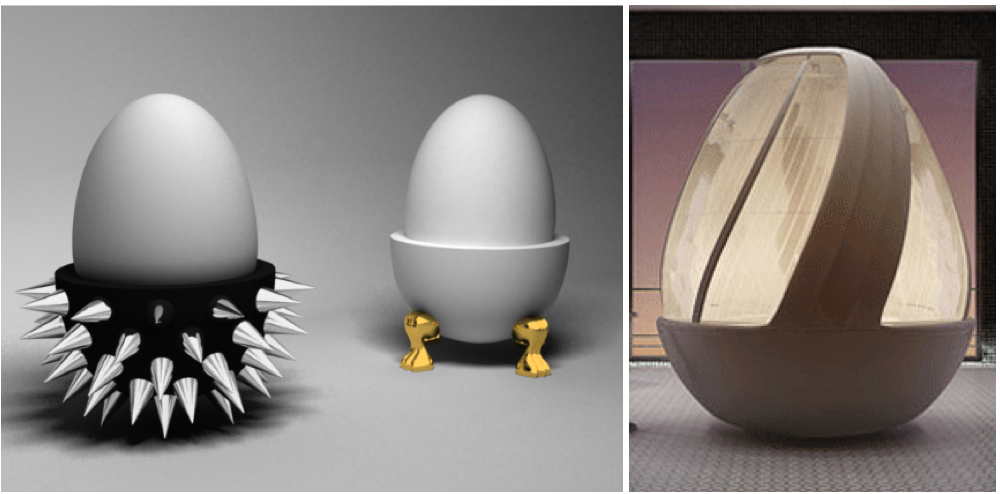
When we started talking about our perception of space (motivated by the images and post about surfaces and the delimitation of spaces) Raquel mentioned the work of Rachel Whiteread and how she produces spaces and shapes that are the "negative" of what we see. In other words, Witheread makes visible what is normally the empty-space that surrounds the matter-space. Whiteread´s sculptures (concrete, plaster) are probably not related to our pursue (in terms of grammar), but the thought is really interesting. The conversation went on to the appropriation of space and the relationship between the individual space (or the space for the adult plus the baby) and the collective space (the 6 adults and their babies, in the case of the ZYG for families or the 9 children and their carers in ten case of kindergartens). It would be nice if the installation would allow the "individual hug" (a sense of comfort and protection in the relationship between the adult and the baby) as well as the collective experience (being with other people in the same enclosed space). This was partially motivated by the posts about "cocoons", and therefore we looked at about variations on the same theme and soon we started to talk about egg-chairs and other egg-related ideas. Here are some examples of egg-chairs:


There are many other possibilities, including the Flux-chair, a foldable one:


Here is an idea of a space that would simultaneously allow for the individual (egg-chair-type structures made of rigid material being transportable as pieces that would pile up inside each other) and collective (the individual "eggs" would connect and define a the base of the "bigger egg", the top could be something umbrella like, not rigid). 

Raquel, since then, has send some more eggs.